
How does the contact/company duplicate check feature work and how can I merge duplicate records?
Neoserra includes tools to help you identify, prevent, and resolve duplicate client and contact records. Keeping your database free of duplicates is essential for accurate reporting, complete client histories, and consistent data across your network.
This FAQ explains how Neoserra identifies possible duplicates; how to prevent duplicate records; how to find existing duplicates; and how to merge records when appropriate.
- How Neoserra Identifies Possible Duplicates
- Exact Matches Matter
- How to Prevent Duplicate Records
- Finding Existing Duplicate Records
- Determining Whether Records Are Duplicates
- Merging Duplicate Records
- When Neoserra Identifies a False Positive
- Why Avoiding Duplicate Records Matters
How Neoserra Identifies Possible Duplicates
Neoserra automatically checks for possible duplicates when you create a new client or contact, or when you process new records received through eCenter Direct. Depending on the type of record being entered or processed, Neoserra may display possible duplicates alongside the entry form or display a warning at the top of the page.
When adding a new client
As you begin typing a company name, Neoserra displays possible duplicate client records in the right-hand panel. As you enter more characters, the list narrows.

Review any potential matches before creating a new record. If the client already exists, use the existing record rather than creating another one.
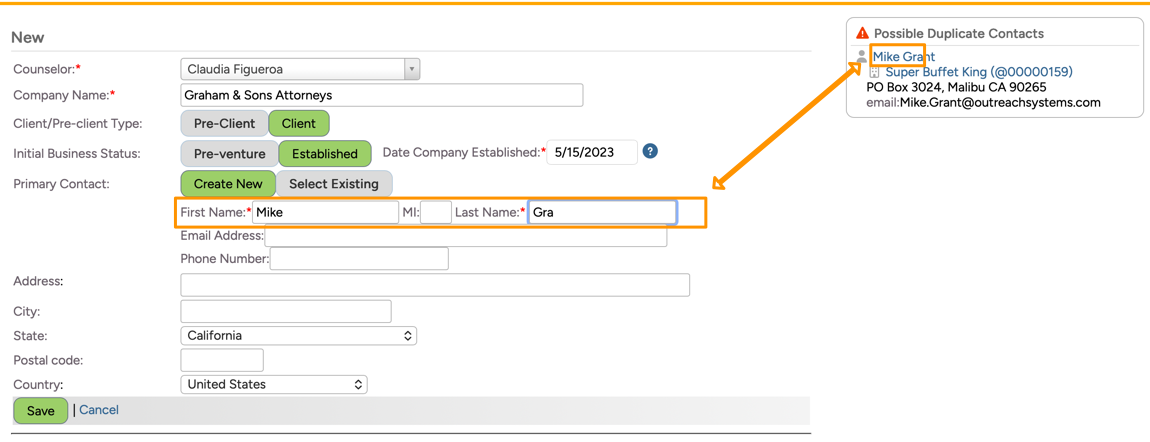
As you continue typing the contact information, then Neoserra will also check to see if a duplicate contact already exists:
When adding a new contact
If you enter a new contact, independent from creating a new client record, then Neoserra will go through the same process. As you enter the new contact's name, Neoserra displays possible duplicate contacts in the right-hand panel. Review the results before creating a new contact to avoid splitting the person's training participation and activity history across multiple records.
When processing eCenter Direct sign-ups
When processing a new client record received through eCenter Direct, Neoserra displays a yellow warning bar if it detects a possible duplicate based on the company name, address, email address, or phone number.
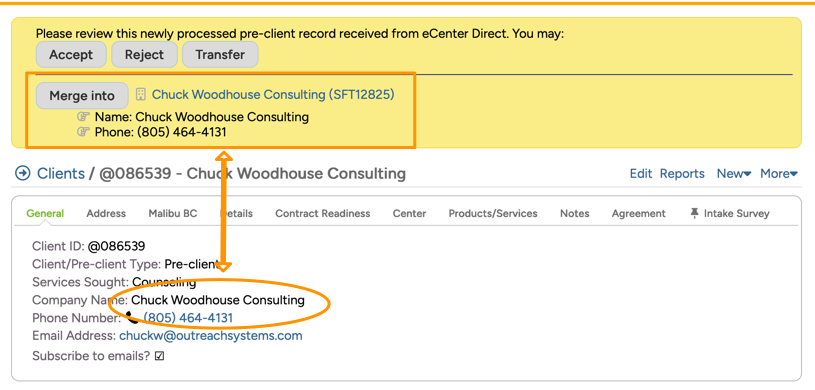
A similar warning appears when processing a new contact record if a potential duplicate is detected.
Exact Matches Matter
Neoserra's duplicate detection can be sensitive to individual characters, including spaces and punctuation. For example, these company names are not identical:
- ABC Company
- A.B.C. Company
- A B C Company
- Alpha Beta Charlie Company
Differences in spelling or punctuation can also prevent records from appearing as possible duplicates.
How to Prevent Duplicate Records
Preventing duplicates is easier than resolving them later. Before creating a new client or contact:
- Review the possible duplicates displayed by Neoserra.
- Check existing records carefully before creating a new one.
- Confirm that a new record is genuinely different from any existing record.
Make sure counselors have appropriate permissions to view records across the network. Duplicates frequently arise when counselors cannot see records belonging to other centers. A client who visits multiple centers may consequently be entered into the database more than once. OutreachSystems recommends that system administrators provide counselors with, at a minimum, view permissions across the entire database, where appropriate. This allows counselors to identify existing clients and contacts throughout the network before creating new records.
If one contact owns or works for multiple companies, you can link that contact to multiple client records instead of creating a separate contact record for each company.
Finding Existing Duplicate Records
Neoserra provides built-in reports to help identify duplicate clients and contacts. Regularly reviewing these reports can help you detect problems before they affect reporting or client histories.
These Client reports are available from View|Clients|Reports|Reports:
- Duplicates by Company Name. This report lists out all client records that share the exact same company name as another client record in the database.
- Duplicates by Company Phone. This report lists out all client records that share the exact same company phone number as another client record in the database.
- Duplicates by Company Name and Phone. This report is more restrictive than the previous two; it requires that both company name and phone be shared by two client records.
Neoserra also has two built-in reports dedicated to duplicate contact records available from View|Contacts|Reports|Reports:
- Duplicates by Name and Phone. This report lists out all contact records that share (1) the exact same last name, (2) the same first letter of the first name, and (3) the same phone number as another contact record in the database.
- Duplicates by Email. This report lists out all contact records that share the exact same PRIMARY email address as another contact record in the database. For purposes of this report, the secondary email address is ignored.
These reports are case-insensitive but not punctuation-insensitive. For example, OutreachSystems and OutReachSystems are treated as identical company names, whereas OutreachSystems Inc. and OutreachSystems, Inc. are treated as different names (note the added comma.)
Determining Whether Records Are Duplicates
Neoserra's Possible Duplicates panel identifies records that may be duplicates:
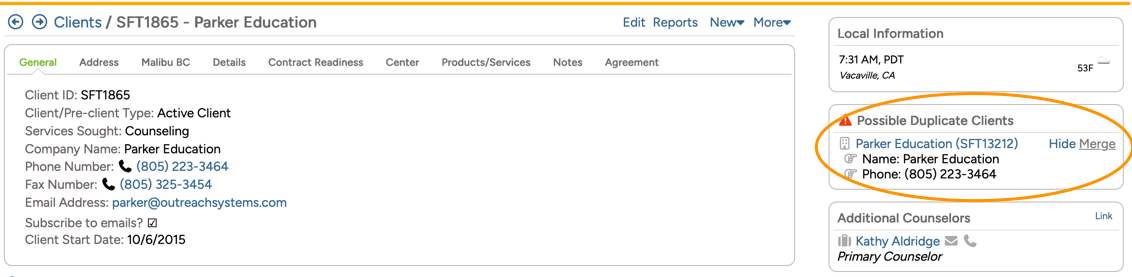
The merge feature is only made available when two clients appear to be true duplicates of one another. A client may be seen as a possible duplicate of another client if:
- The company's name matches another company name with a wildcard at the end
- The company's email matches another company's email address
- The company's primary phone number matches another company's primary phone number
- Optionally, you can also check for duplicates based upon the company's street address as set on the Administration|Configuration|General Settings page
A contact may be seen as a possible duplicate of another contact, if the following condition is met:
- The contact's first, last and email address match another contact's first, last and email address
What if you know you have two duplicate clients but they are not appearing in the "Possible Duplicates" pane? This can happen when one of the two companies is misspelled or if one of the two companies includes punctuation that is not found in the other company. For example, the following two clients are not a perfect match and will not appear as possible duplicates because of the added comma in the first name:
- iConsulting Group, Inc.
- iConsulting Group Inc.
Similarly, the following two companies are not seen as duplicates by Neoserra due to the typo in the second name:
- Saskatchewan Architects
- Saskatchewen Architects
Unfortunately, if you know that there is a duplicate in the database but due to misspellings or punctuation the duplicate is not appearing, then the best thing to do is to make them be duplicates by editing the company name. In other words, for the first example listed above, you can remove the comma of the first entry and then you should be able to merge the two records. If Neoserra doesn't think that they are duplicates of each other but you know that they are, then you can edit the records to make them truly appear as duplicates to Neoserra.
Merging Duplicate Records
When two records represent the same client or contact, Neoserra may allow you to combine them using the Merge feature in the Possible Duplicates panel:
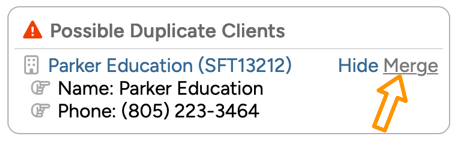
The merge feature is offered within the Possible Duplicates panel on the right hand side of either the contact or the client record. There are two commands you can use here: "Merge", and "Hide." If Neoserra is identifying a "false positive" then you can click on the "Hide" option to make the possible duplicates disappear for all Neoserra users.
The Merge and Hide options are only offered assuming you have the appropriate level permissions.
To merge two client records you will need the following permissions:
- Edit (including edit center) permissions to both records, PLUS
- Delete permissions to both records
To merge a client and pre-client record, where the pre-client is the victim record; or to merge two pre-clients, you will need the following permissions:
- Edit (including edit center) permissions to both records
To merge two contact records you will need the following permissions:
- Edit (including edit center) permissions to both records
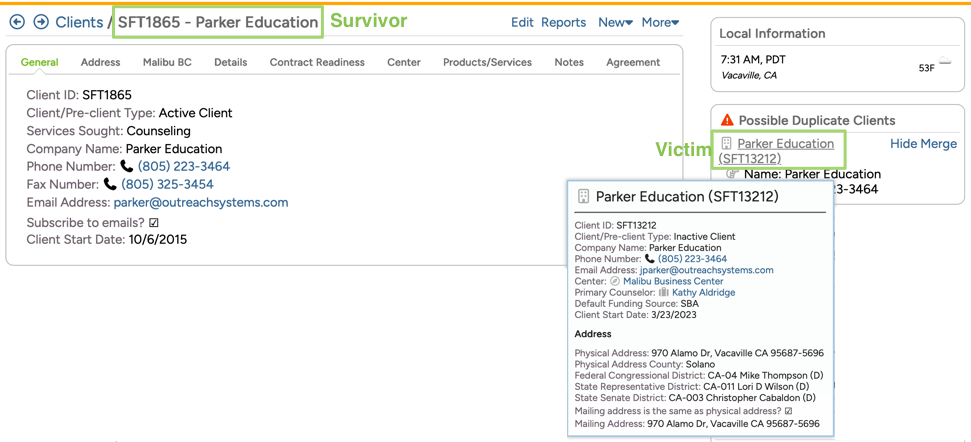
Survivor and Victim Records
Every merge involves two records:
- Survivor: The record that remains in Neoserra. Its internal ID is retained.
- Victim: The record being merged into the survivor. The victim record is permanently deleted.
By default, the record from which you initiate the merge is the survivor, although Neoserra applies certain rules automatically.
Use the following guidelines when deciding which record should survive:
- Client and pre-client: Neoserra automatically makes the client record the survivor.
- Two client records with no activity: Use the most recently entered client record as the survivor.
- One client with activity and one without: Keep the client record with activity.
- Activity in different fiscal years: If one client has activity only in the current fiscal period and the other has activity in prior fiscal years, keep the client with the older activity.
- SBA acceptance: If only one client has been accepted into the SBA backend system, keep that client as the survivor. If both have been accepted, do not merge them.
- Bid match profiles: The client with the active bid match profile must be the survivor. If both clients have profiles, one must be inactivated before merging.
Important: A merge cannot be undone. Review the records and all relevant fields carefully before proceeding.
Neoserra retains the older signature start date when the date precedes or equals the first counseling session of the combined client records.
To merge two record, go to the record whose underlying client ID you want to retain. It will be the record whose details are shown on the page. Review the Possible Duplicates panel. Confirm that the records represent the same client or contact by hovering over the victim record:
Select Merge beside the record you want to merge into the current record. Review the fields presented during the merge process and choose which values to retain when the records differ:
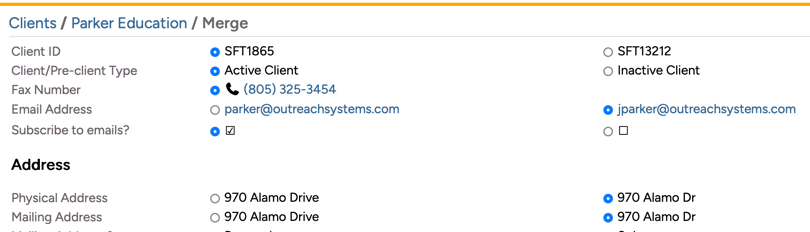
Carefully verify your selections before completing the merge. For example, the victim record might have a more current phone number or address, while the survivor contains more complete client information. Please note that differences in client status can affect reporting. For example, merging records where one indicates that the business is already operating and the other indicates that it is pre-venture may affect business start counts. Carefully choose the appropriate value for each field. Once the merge is complete, the victim record is permanently deleted and its activity records are combined with the survivor's activity records.
For client records, the survivor's primary point of contact remains the primary contact after the merge. The victim's point of contact is added as an additional contact. If both client records contained the same contact as separate records, you may need to merge those duplicate contact records separately.
When merging contacts, the victim contact cannot be the primary contact for any client.
What to Do When Both Client Records Have Been Exported to SBA
Neoserra does not allow two client records to be merged if both have been exported to the SBA backend system. This restriction protects data integrity and helps avoid reconciliation problems during audits. If you discover two duplicate clients that have both been exported to SBA:
- Identify the record that should no longer be used, typically the one with less recent activity.
- Inactivate that client record.
- Change its name to XXX (DO NOT USE), replacing XXX with the original company name.
- Instruct counselors not to add any further sessions to the retired record.
- You may also consider moving the retired record to a separate center that counselors cannot access. However, doing so may prevent counselors from viewing the client's historical activity, so consider this consequence before changing the record's center.
Most importantly, do not continue adding sessions to both records.
When Neoserra Identifies a False Positive
Sometimes Neoserra identifies two records as possible duplicates even though they represent different clients or contacts. In this situation, use Hide in the Possible Duplicates panel to dismiss the false positive. The record will no longer appear as a possible duplicate for other Neoserra users. You can expose the possible duplicate again if necessary. Do not merge records simply because they appear in the same list. Always verify that they represent the same person or organization.
Why Avoiding Duplicate Records Matters
Duplicate records compromise the integrity of your database and can lead to:
- Inaccurate reporting, including overstated counts of new clients counseled.
- Confusion about which client record counselors should use.
- Incomplete client histories because activity is distributed across multiple records.
- Difficulties reconciling records that have already been submitted to SBA.
Duplicates are especially difficult to resolve after records have been exported to SBA, making early detection and prevention essential.
Want more? Browse our extensive list of Neoserra FAQs.